Textiles & Standards
Inside Coyuchi’s Organic Fiber Standards: What GOTS Covers—and What It Doesn’t
A certification label can make a complicated textile supply chain look reassuringly simple. GOTS offers meaningful information about organic fibers and certain stages of processing, but it is not a universal verdict on a blanket’s durability, animal welfare, or every part of its journey.
Published October 24, 2026
There is a small moment of relief in finding a certification on a bedding label. The word seems to tidy the room: the cotton is organic, the wool is responsible, the process has been examined. In a market where claims such as “natural,” “clean,” and “sustainable” are often asked to carry more meaning than they can comfortably support, a formal standard offers something better than atmosphere. It offers defined criteria.
For shoppers reading descriptions of Coyuchi organic bedding, one of the most prominent of those criteria is GOTS—the Global Organic Textile Standard. The name appears on products and in discussions of organic fiber sourcing, processing, and textile production. It is a useful signal, but not a magic word. GOTS addresses specific materials and stages of production under its rules; it does not automatically answer every question a reader might have about a finished blanket or comforter.
That distinction is not a reason to distrust certification. It is a reason to read it with care. The best way to understand a GOTS claim is to separate what the standard verifies from the other facts that help describe a product: the percentage of each fiber, where the fibers came from, where the textile was woven, how it was finished, and how it should be cared for. Those details are not redundant. Together, they make a label legible.
What GOTS is designed to assess
GOTS is a standard for organic textiles. Its scope begins with organic fiber content and extends into specified requirements for processing and manufacturing. That is important because a fiber does not become a finished blanket in a single, uncomplicated step. It may be grown or raised, cleaned, spun, dyed, woven or knitted, finished, and assembled, with different businesses handling different portions of the work.
A credible textile standard therefore has to look beyond the fiber’s original source. GOTS sets requirements for participating stages of the supply chain and for certain environmental and social conditions at certified processing and manufacturing facilities. It includes restrictions and controls relating to inputs used in processing, as well as requirements concerning wastewater and other environmental practices. It also contains provisions addressing working conditions and labor protections within its scope.
The practical implication is that GOTS means more than “some organic material is present.” Certification is tied to documented requirements and to a chain of custody through relevant certified businesses. The precise claim depends on the product’s fiber content and the applicable labeling rules. A reader should not assume, however, that seeing a certification mark means every business, farm, transport provider, or material in the product’s wider history has been independently assessed in the same way.
This is the first useful boundary: GOTS is a textile standard, not an all-purpose certificate for every virtue a consumer might hope to find. It addresses defined parts of textile production. Its value lies partly in that specificity. Its limits lie there, too.
Organic content is not a vague adjective
The word “organic” can sound singular, as though it describes an entire object in one stroke. Textiles, being mixtures of fibers and processes, make that shorthand complicated. A blanket might contain one fiber, two fibers, or several. Its fabric, stitching, trim, and other components may not all be made from the same material. Certification claims must therefore be read in relation to the product’s composition and the standard’s labeling requirements.
GOTS labeling categories distinguish between products with higher organic fiber content and those that meet a lower permitted threshold. In broad terms, a product labeled “organic” under GOTS requires at least 95 percent certified organic fibers; the “made with organic” category applies to products with at least 70 percent certified organic fibers, subject to the standard’s rules. Other requirements govern what fibers and components may be included and how a claim may be presented. The exact meaning of a particular label should be checked against the current standard and the product’s own certification information.
That percentage matters. It gives a reader a more useful picture than the word “organic” alone. A blend may be a considered textile choice, but it is not the same thing as a textile made entirely—or nearly entirely—from one organic fiber. Knowing the percentage helps prevent a common misunderstanding: certification does not erase the rest of the bill of materials.
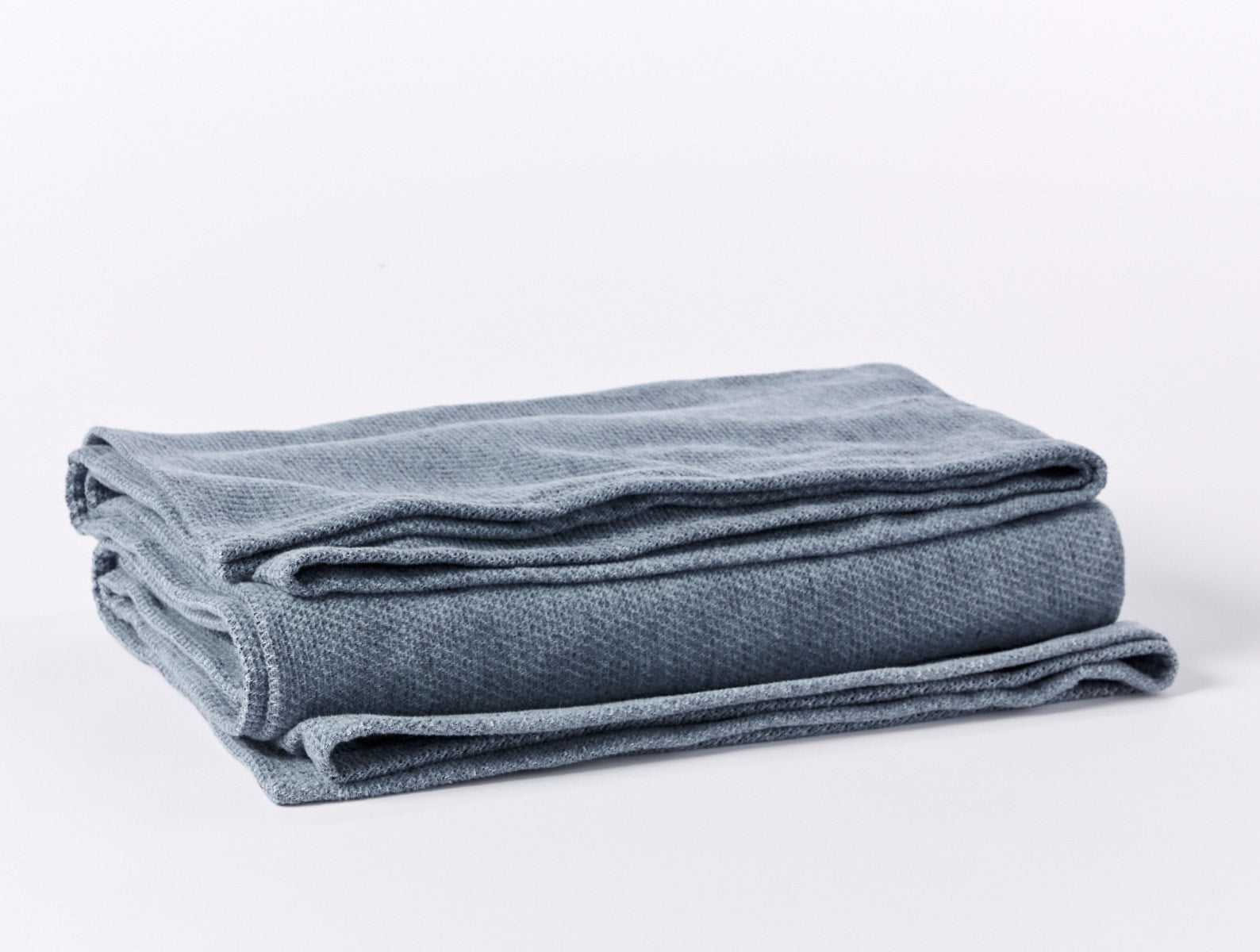
Coyuchi’s Sequoia Washable Organic Cotton and Wool Blanket is a helpful example because its composition is stated plainly: 70 percent organic cotton and 30 percent organic wool. The product information also describes a brushed finish, a weight of 335 grams per square meter, and a double-needle stitched edge. It identifies cotton grown in Turkey, wool from Argentina, and weaving in Germany, and lists GOTS certification. Those are separate pieces of information, each answering a different question.
The fiber percentage describes what is in the blanket. The origin details describe where the listed fibers were grown or sourced and where the fabric was woven. The finish and edge describe aspects of construction. The certification is a claim about compliance with the applicable GOTS requirements, as represented for that product. None of these facts substitutes for the others, and together they provide a far more grounded account than a broad declaration of eco-friendliness.
What a certification does not tell you
GOTS certification does not, by itself, tell you how long a particular blanket will last. Durability depends on the fibers, yarns, weave, finishing, construction, frequency of use, and care. A strong certification may establish standards for materials and processing, but it is not a long-term wear test. For that, readers should look for details such as fabric weight, edge finishing, construction, repairability, and clear care instructions—while remembering that no single specification guarantees performance in every home.
Nor does the label settle every question about animal welfare. Wool raises questions distinct from those associated with plant fibers: how animals are kept, handled, and shorn; how farms manage land; and how wool is traced through the supply chain. GOTS includes animal-welfare-related provisions for organic livestock production within its framework, but a consumer seeking more detailed information about a specific wool source may need additional documentation or a separate, relevant standard. “GOTS certified” should not be inflated into a promise that every possible aspect of animal care has been independently proven to every reader’s satisfaction.
It also does not necessarily supply a complete map of a product’s entire supply chain. A product description may name the origins of its fibers and the country where it was woven, which is useful. Yet those facts do not automatically identify every location involved in spinning, dyeing, finishing, sewing, packing, or transport. Certification concerns the processes and entities covered by the standard and certification system; it should not be casually translated into “every stage, everywhere, has been audited.”
And organic certification is not the same as a general guarantee of safety for every person or every sensitivity. GOTS regulates specified substances and processing inputs under its requirements, but individual reactions vary, and a certification should not be treated as medical advice or as a promise that no one will experience irritation. Likewise, “organic” does not necessarily mean low-impact in every environmental dimension. Water, energy, land use, emissions, packaging, and shipping may be relevant questions, but no single label answers all of them.
Finally, certification does not determine whether a blanket is right for a particular sleeper, climate, or household. A breathable wool blend might suit one person and feel too warm to another. A machine-washable textile may be more practical for one home than a piece whose care instructions recommend dry cleaning. The standard helps clarify production criteria; comfort remains stubbornly personal.
Certification and product details: two kinds of evidence
It is tempting to treat a certification as the entire story, especially when the logo is more visually prominent than the technical information. But a careful reader can use the label as a starting point and the product description as a second layer of evidence. One says something about conformity with a defined standard. The other can offer specifics about composition, origin, construction, and use.
For a wool blanket, useful questions include: What percentage is wool, and what makes up the remainder? Is the wool described as organic? Where is it sourced? Where is the textile woven? What is the fabric weight? How is the surface finished? How should the blanket be washed, dried, or stored? If a product page says that a blanket is machine washable, is that instruction explicit, and does it specify water temperature and drying conditions? These details help a reader understand both the textile and the work required to maintain it.
The Sequoia blanket’s description, for instance, says that the fibers are twisted together before weaving, that the fabric is brushed for softness, and that it can be cold-washed on a gentle cycle with like colors, then tumble-dried on low and removed promptly. This is not information supplied by the phrase “GOTS certified.” It is practical care guidance, presented alongside the certification and material breakdown.
The distinction is especially useful when comparing blended bedding. A cotton-and-wool blanket is not simply a wool blanket with a footnote. Cotton and wool bring different characteristics to the cloth, and their proportions influence its feel and use. The 70/30 composition identifies the balance; the weight and weave add further context. A reader can then decide whether the stated materials and care routine suit the intended room and household.
How to read a GOTS claim without overreading it
A useful reading habit begins with the exact wording. Is the item described as GOTS certified, or does the page say that a particular fiber or component is certified? Does the certification appear in the product information, on the product label, or only in a general brand statement? Those distinctions do not automatically prove or disprove a claim, but they tell you what information is being offered and where a follow-up question may be useful.
Next, look for the fiber percentages. “Organic cotton and wool” is less informative than a statement that gives the proportions. If the product is blended, identify the other fibers and ask whether they are also included in the certification claim. A threshold category can explain how a blend qualifies under the standard, but the percentage is still essential for understanding the object itself.
Then read the origin and manufacturing information as its own account. A statement that wool comes from one country and a blanket is woven in another is not an inconsistency; textile production commonly spans borders. It is, however, only as detailed as the statement itself. If a particular question matters—such as whether a mill is certified, or where a finishing process took place—the most direct source is the brand’s current product documentation or a relevant certification record.
Finally, distinguish between a standard’s scope and a company’s broader claims. A brand may provide further information about sourcing, animal welfare, labor, environmental initiatives, or product longevity. Those claims may be important, but they should be assessed on their own terms rather than automatically attributed to GOTS. A useful question is not merely “Is this certified?” but “Which claim is certified, under which standard, and what other evidence supports the rest?”
The modest virtue of precision
There is a tendency in consumer language to ask a single label to resolve an entire moral and practical landscape. The blanket should be soft, durable, responsibly sourced, harmless, low-impact, fairly made, easy to wash, and somehow free of trade-offs. Certification can contribute to a more accountable system, but it cannot compress every one of those questions into a single mark.
That limitation is not a defect unique to GOTS. It is a feature of standards generally: they set boundaries, define requirements, and make certain claims more verifiable. Their precision is valuable precisely because they do not claim to be everything. A reader who knows the boundary can use the standard well; a reader who mistakes it for a universal endorsement may ask it to do work it was never designed to do.
Coyuchi’s organic bedding provides a practical setting for this kind of reading. In a product such as the Sequoia blanket, certification appears beside a stated fiber blend, geographic sourcing information, construction details, weight, and care instructions. Taken together, these details help describe a textile without requiring one claim to stand in for all the others. They also make it possible to ask more precise questions when the published description leaves something unresolved.
The better conclusion is neither that a certification tells us everything nor that it tells us nothing. GOTS can offer meaningful evidence about organic fiber content and specified processing, environmental, and social requirements within its scope. It cannot independently guarantee every feature of a finished product or every stage of its wider supply chain. Read carefully, the label is a useful beginning: a standard with defined reach, and a reminder to look at the material, the making, and the maintenance of the blanket itself.
A quick guide to reading organic bedding claims
- Check the exact certification claim. Identify whether it applies to the finished textile and what the product information says is certified.
- Read the fiber percentages. A blend’s composition gives a clearer picture than a general reference to organic materials.
- Separate certification from origin. Fiber source, weaving location, and other manufacturing details answer different questions.
- Look beyond the label for performance. Weight, construction, finishing, and care instructions help explain how a blanket may function in daily use.
- Ask what remains unspecified. Durability, detailed animal-welfare practices, and parts of the supply chain may require additional information.